Property video is no longer viewed in just one place.
A potential buyer might first discover a home through a vertical social media clip on their phone, then open the full listing on a laptop and watch a detailed property walkthrough later.
That creates an important decision for real estate agents and property marketers: Should a property walkthrough video be vertical or horizontal?
The answer depends on what the video needs to accomplish.
Vertical video is a natural fit for mobile-first channels such as TikTok, Instagram Reels, Stories, and YouTube Shorts. Horizontal video, meanwhile, remains highly useful for full property tours, listing pages, agent websites, desktop viewing, and traditional long-form video.
Neither orientation is automatically better.
The most effective choice depends on the platform, the property, the audience, and the role the video plays within your real estate marketing strategy.
This guide compares vertical vs horizontal video for property walkthroughs and explains when each format makes the most sense.
Vertical vs. Horizontal Video: What’s the Difference?
The basic difference is the shape of the video frame.
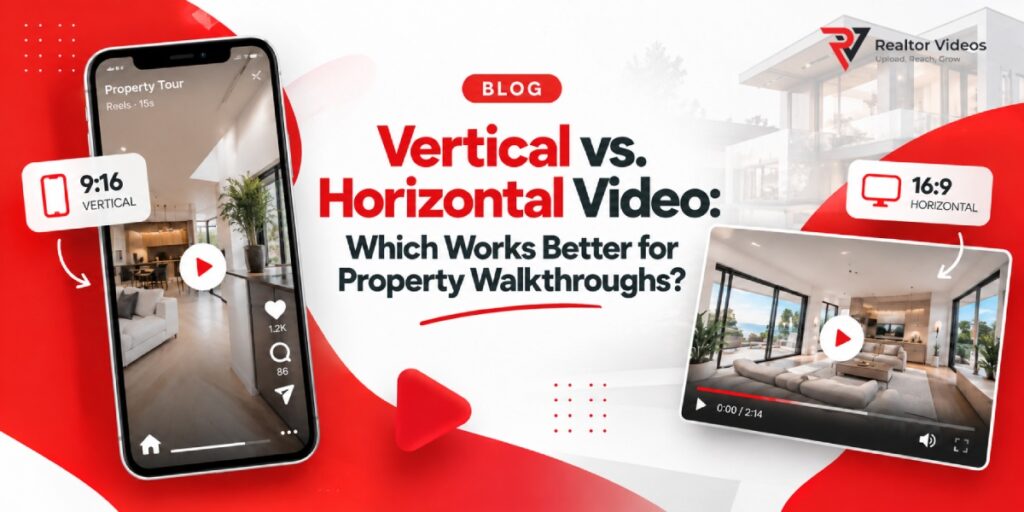
Vertical video is taller than it is wide. A common vertical format is 9:16, which fills most smartphone screens when the phone is held upright.
Horizontal video, sometimes called landscape video, is wider than it is tall. A common horizontal format is 16:9, the format widely associated with televisions, computer monitors, website players, and traditional online video.
YouTube, for example, identifies 16:9 as its standard aspect ratio on computers, although its player can adapt to videos with other aspect ratios. YouTube Shorts can use square or vertical video formats.
TikTok’s own creative guidance also emphasizes 9:16 vertical video for a full-screen viewing experience.
The orientation changes more than the dimensions of the video. It changes how much of a room viewers can see at once, where the viewer’s attention goes, and how naturally the footage fits the platform where it is published.
That is why agents should ideally decide where a realtor video will be used before shooting or editing it.
Vertical Video for Property Walkthroughs
Vertical real estate video has become increasingly useful because so much property discovery now happens on mobile devices and social feeds.
For agents trying to introduce a property quickly, vertical footage can be an excellent format.
Advantages of Vertical Video
It fits mobile screens naturally.
A 9:16 video can occupy most of the available smartphone screen without requiring the viewer to rotate their device.
This makes vertical video particularly useful for:
- Instagram Reels
- Instagram Stories
- TikTok
- YouTube Shorts
- Facebook Stories and similar mobile placements
- Short property highlight clips
Vertical framing can also create a more immersive view when showing tall features such as staircases, double-height ceilings, large windows, entryways, cabinetry, or architectural details.
It works well for quick property discovery.
A short vertical video does not necessarily need to provide a complete tour.
Instead, it can introduce the property through a few compelling moments:
“Take a look inside this waterfront home.”
“Three features that make this kitchen stand out.”
“Wait until you see the backyard.”
This makes vertical video particularly useful at the discovery stage of real estate video marketing.
Limitations of Vertical Video
The biggest limitation is horizontal space.
Homes contain many spaces that are naturally wide: kitchens, open-plan living rooms, dining areas, large bedrooms, commercial interiors, outdoor entertaining areas, and panoramic views.
A vertical frame may show only part of that space at once.
This can make it harder for viewers to understand:
- Room dimensions
- Room-to-room relationships
- Wide architectural features
- Open floor plans
- Large outdoor areas
- The overall flow of the property
Vertical property video can still work well for walkthroughs, but careful composition becomes especially important.
It may also feel less natural when embedded in certain website layouts or viewed on larger desktop displays.
Horizontal Video for Property Walkthroughs
Horizontal video remains particularly valuable when the objective is to give viewers a fuller understanding of the property.
The wider frame can show more of a room at once, which is useful for establishing space and layout.
Advantages of Horizontal Video
Horizontal video is especially useful for:
- Full property walkthroughs
- Listing pages
- Property websites
- Agent and brokerage websites
- Long-form YouTube videos
- Desktop viewing
- Luxury property presentations
- Large rooms and wide interiors
- Commercial real estate
- Detailed new-construction tours
For realtor videography, one of horizontal video’s biggest strengths is spatial context.
Imagine filming an open-plan kitchen, dining area, and living room.
A wide frame may allow all three spaces to appear together, helping viewers understand how the property is arranged. A narrow vertical frame may require several separate shots to communicate the same information.
Horizontal video can therefore be particularly effective when the walkthrough itself is intended to help buyers understand how a property flows. Once the walkthrough is ready, agents can embed a video on their real estate listing page to help potential buyers explore the property directly from its listing.
Limitations of Horizontal Video
Horizontal footage does not always fit naturally into vertical mobile feeds.
When displayed within a portrait-oriented social environment, a landscape video may appear smaller or require cropping, reframing, or another platform-specific presentation.
Cropping a 16:9 shot into 9:16 after filming can also create problems. Planning your footage around the intended platform can make editing easier. Understanding different property video formats can also help you choose a suitable format for video quality, compatibility, and playback.
Important visual information near the left or right edges may disappear. A person, room feature, window, or piece of on-screen text can easily be cropped out.
That is why simply filming everything horizontally and assuming it can be converted perfectly into vertical content later is not always ideal.
Vertical vs. Horizontal: Which Is Better for Real Estate?
There is no universal winner.
A useful way to compare the two is to consider the intended viewing experience.
| Factor | Vertical Video | Horizontal Video |
|---|---|---|
| Mobile viewing | Excellent | Good |
| Mobile-first social feeds | Excellent | Good |
| Full property walkthrough | Good | Excellent |
| Wide rooms and interiors | More limited | Excellent |
| Website embedding | Good | Excellent |
| Desktop viewing | More limited | Excellent |
| Reels, Stories, TikTok | Excellent | Less natural |
| YouTube long-form | Possible | Excellent |
| Quick property highlights | Excellent | Good |
| Showing complete spatial context | Good | Excellent |
| Short-form discovery content | Excellent | Good |
These should not be treated as absolute rules.
A beautifully composed vertical apartment tour can be more effective than a poorly produced horizontal walkthrough. Likewise, a strong 16:9 property video may still perform well on mobile when it is presented in the right context.
The format should support the marketing goal, not dictate it.
Which Format Is Better for Different Property Types?
The type and scale of the property should influence your decision.
Apartments and Condos
Vertical video can work particularly well for compact apartments and condos, especially when the main marketing channel is social media.
Smaller spaces may also be easier to communicate through quick vertical sequences.
However, horizontal footage can be useful when showing an open floor plan, balcony view, or the relationship between multiple living areas.
Practical approach: Use vertical content for discovery and a horizontal walkthrough for the full listing experience.
Single-Family Homes
For a standard single-family home, horizontal video is often a strong choice for the main property walkthrough because it provides more room to establish layout and scale.
Vertical clips can then highlight individual features such as the kitchen, primary suite, backyard, home office, or renovated bathroom.
Luxury Properties and Large Estates
Horizontal video is particularly useful when presenting expansive architecture, landscaped grounds, panoramic views, large entertaining areas, pools, and connected interior spaces.
Luxury homes often rely on atmosphere and scale, both of which can benefit from a wider composition.
Vertical versions still have value for short social promotions and individual standout features.
Commercial Properties
For offices, retail spaces, warehouses, hospitality properties, and other commercial real estate, horizontal video will often provide stronger spatial context.
Buyers and tenants may need to understand room dimensions, floor layouts, circulation, access, and overall scale.
Vertical clips can still support social promotion, but the primary walkthrough may benefit from landscape framing.
New Construction
Both formats can work well.
Horizontal video can show floor plans, model homes, construction progress, finishes, and community amenities in more detail.
Vertical clips are useful for highlighting individual design features, project updates, or newly completed areas.
Rental Properties
For rental apartments and homes promoted primarily through social channels, vertical video can be especially practical.
For higher-value rentals or listings supported by a dedicated property page, creating a horizontal walkthrough as well can provide a more complete presentation.
Which Format Is Better for Different Real Estate Platforms?
The distribution channel should heavily influence orientation.
Instagram Reels and Stories
Vertical video is generally the natural choice.
These formats are designed around mobile viewing, so a vertical property clip can use screen space more effectively.
TikTok
Vertical 9:16 footage closely matches TikTok’s full-screen viewing environment, and TikTok’s own creative guidance recommends the format.
Short property highlights, before-and-after renovations, unusual features, luxury details, and quick walkthrough sequences are all well suited to this format.
YouTube
The correct format depends on the type of content.
For a traditional long-form property walkthrough, 16:9 remains a natural choice, particularly for desktop and television-style viewing. For YouTube Shorts, vertical or square video can be used.
The best format depends on placement.
A property video used in mobile-first placements may benefit from vertical framing, while a video shared on a listing page, website, or traditional video post may work well horizontally.
Real Estate Websites and Property Pages
Horizontal video is usually the more natural choice for a primary walkthrough.
A wide embedded player can integrate neatly into a property page while giving viewers more room to understand interiors. When publishing videos on your website, follow Google’s video SEO best practices to help search engines discover and understand your video content.
Email Marketing and Direct Video Links
Either format works because viewers can open the video separately.
The more important consideration is where the link leads and whether the viewing experience is appropriate for both mobile and desktop users.
Should Realtors Create Both Vertical and Horizontal Videos?
For many agents, this is the most practical answer.
Instead of asking one format to do everything, create different versions for different parts of the marketing campaign.
A simple workflow could look like this:
- Record high-quality property footage with both final formats in mind.
- Produce a detailed horizontal walkthrough for the listing page or property website.
- Create shorter vertical cuts from suitable footage.
- Use vertical clips for Reels, TikTok, Stories, and Shorts.
- Use the full horizontal tour where buyers want more detail.
- Share whichever version best matches the channel and buyer intent.
This approach allows one property shoot to support several marketing assets.
However, plan for both orientations before filming whenever possible.
If you know an important shot must work vertically and horizontally, keep key property features reasonably close to the center of the frame or capture dedicated versions of that shot.
Best Practices for Property Walkthrough Videos
Regardless of orientation, strong execution matters more than simply choosing 9:16 or 16:9.
Start with a strong property feature. Give viewers an immediate reason to continue watching.
Keep camera movement controlled. Smooth movement makes rooms easier to understand.
Show room-to-room flow. A walkthrough should help viewers develop a mental picture of the property.
Use consistent framing. Constant changes in visual style can make the tour feel disconnected.
Protect important details. Keep text, people, and important property features away from areas that may be cropped or covered by platform interface elements.
Use good lighting. Orientation cannot compensate for dark, poorly exposed footage.
Avoid unnecessary shots. Every clip should reveal something useful or strengthen the property’s presentation.
Use captions when appropriate. On-screen text can communicate property details even when viewers are watching without sound.
Think about the destination before editing. A video designed for a property website should not automatically use the same composition and pacing as a social Reel. Choosing the right property video formats can also help you prepare footage for different viewing environments.
Where Should Realtors Host Property Videos?
Publishing property clips on social media is useful for discovery, but social platforms are only one part of a complete real estate video strategy.
Agents and brokerages may also need dedicated links for buyers, embedded walkthroughs for property pages, centralized video management, privacy options, and a clean viewing experience.
A dedicated real estate video hosting platform can support those workflows alongside social distribution.
The Realtor Videos is designed for hosting and sharing existing property videos. Its features include direct video links, iframe embeds, ad-free playback, privacy settings, domain-level embed controls, centralized video management, and engagement analytics.
Social media does not need to be replaced. Instead, agents can use social channels to introduce a property and share hosted walkthroughs on listing pages or agent websites to provide buyers with a more focused viewing experience.
For agents who want to display videos directly on their property pages, this guide explains how to embed a video on your real estate listing page. You can also explore MLS-friendly video hosting when planning how to share property videos across real estate marketing channels.
Vertical or Horizontal: A Simple Decision Guide
Choose Vertical When:
- Your primary audience will discover the video on a phone.
- The content is intended for Reels, Stories, TikTok, or Shorts.
- The goal is quick property discovery.
- You are highlighting one or two key property features.
- The footage is designed as short-form promotional content.
Choose Horizontal When:
- You are creating a full property walkthrough.
- The video will be embedded on a property or agent website.
- A meaningful portion of the audience may watch on desktop.
- Showing complete rooms and spatial relationships is important.
- The property includes expansive interiors, grounds, or views.
Consider Both When:
- The property is being promoted across multiple channels.
- Social media and website marketing are both important.
- You want short-form discovery content plus a detailed tour.
- The listing is important enough to justify multiple edits.
- You want to maximize the usable content from one property shoot.
Final Verdict: Vertical or Horizontal for Property Walkthroughs?
So, which works better: vertical vs horizontal video?
Neither format is universally better.
Vertical video generally suits mobile-first discovery, especially on platforms and placements built around portrait viewing. It is excellent for short property clips, feature highlights, social media teasers, and quick visual storytelling.
Horizontal video often suits detailed property walkthroughs, especially when viewers need to understand room size, layout, architecture, and how spaces relate. It also fits naturally into many websites, property pages, desktop experiences, and long-form video presentations.
For many real estate professionals, the strongest strategy is not choosing one format and ignoring the other.
Create the main property walkthrough in the orientation that best communicates the home, then adapt selected footage into platform-specific versions.
A detailed horizontal tour can help an interested buyer explore the property. A short vertical clip can help that buyer discover it in the first place.
The right orientation is ultimately the one that matches where the video will be watched, what the viewer needs to understand, and what action you want them to take next.