Publishing a property video is an important step in real estate marketing, but how do you know whether people are actually watching it?
A beautifully filmed home tour may receive hundreds of views without generating meaningful interest. Meanwhile, another video with fewer views could attract viewers who spend more time exploring the property and eventually request a showing.
This is why real estate video analytics matter. Instead of relying on view counts alone, agents and brokerages can use performance data to understand how audiences discover, watch, and interact with their property videos.
Video analytics can help answer important questions: Are people watching your listings? How long do they stay? Which properties attract more attention? Do viewers visit the listing page afterward? Are those visits contributing to actual enquiries?
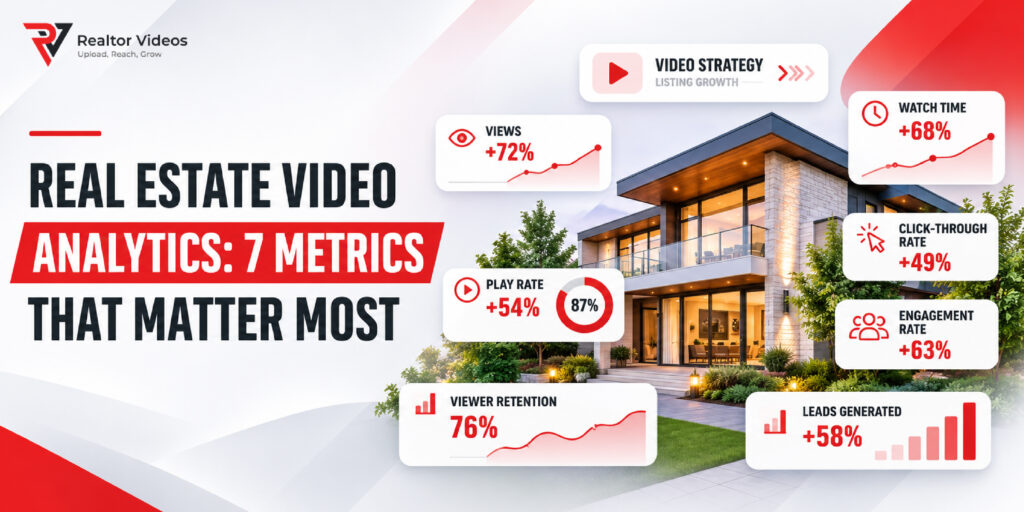
Understanding the right real estate video metrics helps turn these questions into more informed marketing decisions. In this guide, we’ll explore seven useful metrics: video views, watch time, average view duration, audience retention, engagement, click-through activity, and conversions.
Why Real Estate Video Analytics Matter
Real estate professionals invest considerable effort in producing property videos. Filming, editing, hosting, and distributing a walkthrough all require time and resources. Without analytics, it’s difficult to know which parts of that investment are reaching the intended audience. Property video analytics can help agents:
- Understand which listings attract viewer attention.
- Compare the performance of similar property videos.
- Identify content that keeps viewers interested.
- Improve video introductions, pacing, and presentation.
- Evaluate different marketing and distribution channels.
- Make better decisions about future video production.
- Understand how videos contribute to broader property marketing efforts.
However, video performance and business results are not the same. A video with many views demonstrates exposure under the platform’s counting rules. It doesn’t automatically indicate serious buyer interest, qualified enquiries, or completed transactions. The most useful approach combines video engagement metrics, website analytics, and properly tracked business outcomes.
1. Video Views: Understand How Much Attention Your Listings Receive
Video views are among the most familiar real estate video statistics. They indicate how often a video has been viewed according to the hosting platform’s measurement rules.
Total Views vs. Unique Viewers
Total views measure recorded viewing activity. Depending on the platform, repeated viewing sessions may contribute additional views. Unique viewers, when available, estimate how many distinct people or devices watched the video.
For example, a property tour might record 300 views from 220 estimated unique viewers. The difference could indicate repeat viewing, although counting methods and privacy limitations affect interpretation. Not every platform provides unique-viewer data, and different services may use different thresholds to count a view.
How Agents Should Use View Counts
Compare videos with similar characteristics, including property type, marketing period, and distribution exposure. A luxury home promoted through several paid campaigns shouldn’t be compared directly with a smaller listing shared only through an agent’s website.
Practical example: if two comparable listings receive different view counts, review their placement, promotion, and audience reach before assuming the video with fewer views is less appealing.
Views are a useful starting point, not a complete measure of buyer interest.
2. Watch Time: Measure Total Viewing Activity
Watch time measures the combined amount of time viewers spend watching a video. Unlike raw views, it provides additional context about the volume of viewing activity.
For example, suppose two property videos each receive 100 views. One might accumulate 90 minutes of total watch time, while the other accumulates 210 minutes. The difference suggests a greater volume of viewing time for the second video, but it doesn’t explain the cause.
Why Video Length Matters
Longer videos may naturally accumulate more total watch time. A five-minute walkthrough has more potential viewing time per play than a one-minute highlight. For a fairer comparison, consider total watch time alongside video duration, average view duration, and audience retention.
Practical tip: group videos by similar length and property type when evaluating watch time.
Also remember that watch time availability varies by platform. Confirm whether your video hosting service provides this measurement before including it in your reporting.
3. Average View Duration: See How Long Viewers Stay
Average view duration measures the average amount of time watched per recorded viewing session, according to the platform’s methodology. It differs from total watch time because it focuses on the average session rather than the combined time across all views.
A Practical Property Video Example
Consider two hypothetical three-minute listing videos:
| Metric | Property A | Property B |
|---|---|---|
| Video views | 400 | 180 |
| Average view duration | 35 seconds | 125 seconds |
| Video length | 180 seconds | 180 seconds |
Property A attracts more views, but Property B has a substantially longer average viewing duration. This might suggest Property B holds attention more effectively among its audience. However, audience targeting, traffic sources, and viewer expectations may also explain the difference.
How to Improve Average View Duration
Start with a strong opening shot that immediately introduces the home. Avoid lengthy logos, unnecessary introductions, and repetitive camera movement. Feature the property’s most relevant spaces early while maintaining a logical walkthrough. For guidance on pacing, explore the ideal length for a real estate listing video.
Average view duration is especially useful when comparing videos of similar lengths, provided the platform measures them consistently.
4. Audience Retention: Find Where Viewers Lose Interest
Audience retention shows how viewing activity changes throughout a video. On platforms that offer detailed retention graphs, agents may be able to identify where viewers continue watching, skip ahead, or stop. This makes retention particularly useful for evaluating property-video storytelling.
What Audience Retention Can Reveal
Suppose a hypothetical four-minute walkthrough shows a substantial audience drop-off during the first 20 seconds. That pattern may indicate the introduction is too long, the content doesn’t match viewer expectations, or the traffic source is reaching an unsuitable audience. If viewers remain engaged during the kitchen and living room footage but leave during repetitive hallway shots, pacing may deserve attention.
Improve Video Structure Using Retention Insights
- Show a recognizable property feature in the opening seconds.
- Avoid delaying the actual home tour.
- Introduce important rooms earlier when appropriate.
- Reduce unnecessary transitions and repetitive shots.
- Maintain smooth movement and clear visual composition.
For a family home, introducing the living room, kitchen, and backyard early may help establish the layout and key features. Retention data should guide experimentation, not encourage misleading editing or exaggerated property presentation.
Important: detailed audience-retention graphs aren’t available on every video hosting platform. Use them only when your chosen service supports the necessary tracking.
5. Engagement Rate and Viewer Interactions: Look Beyond Passive Viewing
Real estate video engagement includes measurable actions viewers take beyond simply starting playback. Depending on the platform and tracking configuration, these may include:
- Likes or reactions.
- Comments.
- Video shares.
- Clicks on related links.
- Clicks on video calls to action.
- Other supported interactions.
What Does Engagement Rate Mean?
There is no single engagement-rate formula that applies to every video platform. For example, a social video platform might calculate:
Engagement rate = (Likes + Comments + Shares) ÷ Views × 100
If a video received 20 combined interactions from 500 recorded views, that calculation would produce a 4% engagement rate. However, some platforms use impressions, reach, or unique viewers as the denominator instead. Always identify exactly which interactions are counted and which audience measure is used.
How to Interpret Engagement
A property video receiving several relevant enquiries or shares with interested buyers may have more practical value than one collecting casual reactions. Likewise, a hosting platform focused on professional property presentation may not offer public likes or comments. Measure interactions that are genuinely relevant to your marketing goals rather than expecting every video to generate the same engagement signals.
6. Click-Through Rate and Website Traffic: Track the Next Step
A property video can introduce a home, but interested buyers often need more information before deciding whether to contact an agent. This makes clicks and website traffic important parts of real estate video marketing analytics.
Understand Different Traffic Metrics
These measurements should not be confused:
- Video views: recorded viewing activity.
- Video-related clicks: measured clicks on supported links or controls.
- Website sessions: visits recorded by a website analytics system.
- Search impressions: instances where eligible search results appear.
- Listing-page visits: visits to the relevant property page.
A video embedded on a listing page doesn’t necessarily generate a separate website click when someone watches it.
Calculate Click-Through Rate Correctly
When an impression and a corresponding click are measured consistently, CTR can be calculated as:
CTR = Clicks ÷ Impressions × 100
For example, 40 clicks from 1,000 measured link impressions would equal a 4% CTR. The numerator and denominator must refer to the same opportunity for interaction.
Improve the Path From Video to Listing
Provide a clear, relevant next step, such as “View full property details” or “Schedule a showing,” and make sure the link leads to the correct listing and works on mobile. When using video embeds, follow good practices for embedding property videos on listing pages so visitors can easily access both the walkthrough and the property’s details. Use website analytics and appropriately tagged marketing links when attribution across channels is needed.
7. Leads and Conversions: Connect Video Activity to Business Outcomes
The final metric focuses on meaningful marketing results. Views and engagement provide useful information, but agents ultimately want to know whether their marketing helps potential buyers move forward. Depending on the campaign, relevant conversions may include:
- Property enquiry form submissions.
- Contact requests.
- Tracked phone calls.
- Showing appointments.
- Consultation bookings.
- Requests for additional property information.
A Video View Is Not a Qualified Lead
Someone watching a property tour may simply be browsing. A qualified lead generally involves a person who demonstrates relevant intent and meets the agent’s criteria for a potential customer. Not every enquiry will be qualified, and not every qualified prospect will convert immediately.
Understand Attribution Limitations
A buyer might watch a property video on Monday, revisit the website on Wednesday, and call the agent on Friday. Without appropriate tracking, connecting those interactions can be difficult. Website analytics, campaign parameters, conversion events, and CRM records may provide additional context when properly configured, but even then attribution may remain incomplete. Avoid claiming that a specific video directly generated an enquiry unless reliable evidence supports it.
How to Use Video Analytics to Improve Future Property Videos
Collecting data is useful only when it informs better decisions. A practical approach is to identify a performance pattern, investigate possible causes, make a focused improvement, and measure the result.
| Performance pattern | What to review | Potential improvement |
|---|---|---|
| Low video views | Distribution, promotion, placement | Improve visibility on relevant channels |
| Low average view duration | Opening shots, pacing, audience fit | Shorten introductions and improve storytelling |
| Early audience drop-off | First scenes and content relevance | Bring important property features forward |
| High views, few listing clicks | Call to action, link placement | Make next steps easier to find |
| High page traffic, few enquiries | Listing details, contact forms, buyer fit | Improve the enquiry experience |
| Strong engagement | Content structure and distribution | Test successful elements in future videos |
These patterns suggest areas for investigation rather than proving a particular cause. Also review basic production quality: poor playback compatibility or unnecessary loading delays may affect viewing behavior. Consult this guide to compatible property video formats when preparing videos for online distribution. When testing improvements, compare similar properties over consistent time periods rather than relying on one isolated result.
How to Choose a Real Estate Video Hosting Platform With Useful Analytics
Your hosting platform influences how property videos are presented, distributed, and measured. When evaluating video hosting analytics, prioritize capabilities that match your actual marketing workflow.
Look for Useful Performance Information
A hosting solution should provide accessible performance information that helps you evaluate viewing activity. Determine which metrics are included, how they are defined, and whether additional website analytics will be necessary. For example, video-hosting analytics may help measure views or interactions, while lead submissions may require separate website and conversion tracking.
Prioritize a Professional Viewing Experience
An ad-free player can help maintain a focused property presentation. If you’re comparing platforms, consider how ads can disrupt property video viewing. Also look for practical embedding tools, appropriate privacy settings, and controls over where videos can appear.
How RealtorVideos Fits Into Property Video Marketing
RealtorVideos is an ad-free real estate video hosting solution designed for agents, brokerages, and property developers. Its real estate video hosting and analytics features include video performance information, direct links, iframe embedding, privacy controls, and domain-level embed management.
The platform’s public product information identifies views, impressions, clicks, and embed locations among its recorded analytics information. Other metrics discussed in this article, such as detailed retention curves and conversions, should not be assumed to be included in its dashboard.
For listing distribution, agents may also benefit from understanding MLS-friendly video hosting. Local MLS rules vary, so verify requirements before publishing. The right hosting choice should support both a professional buyer experience and the performance information you actually need.
Real Estate Video Analytics Checklist
Use this when reviewing individual property videos or comparing your marketing campaigns.
Video Performance
- Review total video views.
- Compare unique viewers where available.
- Evaluate total watch time when supported.
- Check average view duration.
- Review audience retention where available.
- Monitor relevant viewer interactions.
Website and Business Performance
- Measure relevant video-link clicks.
- Review property listing-page traffic.
- Check traffic from marketing channels.
- Track configured enquiry forms and appointments.
- Evaluate lead quality where records are available.
Continuous Improvement
- Compare similar property videos over consistent periods.
- Review differences in distribution and audience size.
- Identify opportunities to improve introductions and pacing.
- Confirm playback quality and accessible links.
- Test changes and evaluate results over time.
Final Thoughts
Effective real estate video analytics go far beyond counting how many times a property video has been viewed. Views reveal exposure, watch time and retention provide context about viewing behavior, and engagement indicators help identify meaningful interactions. Website traffic, clicks, and properly tracked conversions provide a broader picture of how videos fit into your marketing strategy.
The most useful approach is to combine these measurements, acknowledge tracking limitations, and use the findings to improve future videos.
For real estate professionals seeking a clean, ad-free hosting experience with video analytics and listing-page embedding options, RealtorVideos provides tools designed specifically for property marketing. You can explore RealtorVideos pricing to evaluate the available hosting options for your property videos.